
With strong long-term fundamentals, banking sector cannot be completely ignored

Banking and finance companies, whose dismal performance in late 2008 caused panic among students and faculty members of the premier Indian Institutes of Management, are making up this year with better profiles and stipends.

The new regulations leave registration capital requirements for wholly foreign-owned banks unchanged

Industry players believe the new DFI model will be initially risk capital, which will then be used to mobilise additional resources from development agencies such as World Bank.

The system envisaged under the FRDI Bill, if implemented properly, would help improve the efficiency of capital allocation without harming consumers, and without risking the stability of financial firms, says Ajay Shah.

Of the total 53,334 cases of frauds reported during 2008-09 and 2018-19 fiscal years, involving a whopping Rs 2.05 lakh crore, a highest of 6,811 cases were reported by the ICICI Bank.

'Today, three areas give banks a big headache -- steel, power, infrastructure.' 'Three Cs are very critical in lending -- character, capacity and collateral of the borrower.'

Flight of high-paying banking jobs to other European cities will hurt the prospects of Indian real estate developers and desis in the hospitality business in the UK, says Kunal Bose.
The government has asked the Indian Banks' Association to make sure that IDBI Bank's wages are on a par with other banks.

India's mutual fund (MF) industry had barely any retail footprint when it completed 50 years in 2013. MFs had Rs 7 trillion in assets under management (AUM) in March 2013, of which around Rs 5 trillion was in institution-focused debt funds. By comparison, bank deposits in the country stood at Rs 67.5 trillion around the same time.

Some lenders in talks with LIC for pvt placement

'For years, the RBI has been warning banks on probable frauds in bank guarantees and advised them to exercise due care.' 'PSB staffers feel their jobs are secured, hence there is no need to be vigilant and exercise financial prudence.'
For the first time in our economic history a government has thought about more than 50 per cent of our economic activity instead of the five per cent represented by the Sensex companies, observes IIM-B professor R Vaidyanathan.

The National Stock Exchange (NSE) Nifty Next 50 Index could undergo large-scale changes if the proposed tweaks to its computation methodology get implemented. In a discussion paper floated recently, NSE Indices, which owns and manages a portfolio of over 350 indices under the Nifty brand, proposed that only stocks that are traded in the futures and options (F&O) segment can be part of the index. Currently, as many as 11 non-F&O stocks are part of the Nifty Next 50 Index, which, as the name suggests, represents the next rung of large and liquid securities after the Nifty50.

Regulators will need to allow the model to evolve to allow profits to flow, says Una Gulani.

Banks in talks with temple trusts to push gold scheme

The government has retained Arvind Subramanian as its chief economic advisor, unlike other American professors Dr Raghuram Rajan and Arvind Panagariya, who quit their jobs as RBI governor and NITI deputy chairman respectively.

The government also appointed Dr Vinod Paul, a pediatrician at the AIIMS, as a member of the NITI Aayog

'Modi wants to reverse everything Nehru did, but is shy of touching his daughter's most unwise policies.' 'There is no example of this more stark than bank nationalisation,' says Shekhar Gupta.

The next annual budget of India will have to be very carefully structured to sustain the country's growth momentum, Union Finance Minister Nirmala Sitharaman said on Tuesday, noting that it will also address inflation concerns. Visiting Washington DC to attend the annual meeting of the International Monetary Fund and the World Bank, the finance minister was responding to a question on the next year's Budget at a fire-side chat with eminent economist Eshwar Prasad at the prestigious Brookings Institute. "Specifics (of the next Budget) may be difficult at this stage because it's a bit too early. "But broadly, the growth priorities will be kept absolutely on the top. "Even as I speak about the concerns that inflation brings before me. So, inflation concerns will have to be addressed. "But then how would you manage growth would be the natural question," Sitharaman said.
'The Insolvency and Bankruptcy Code is neither beneficial to banks nor helpful for the borrower.' 'Genuine people who are caught in economic stagnation will lose everything and thousands will lose jobs.'

'We suggest an equity strategy of 5% to 10% exposure to cash, 5% to Gold ETF, close to 50% to Sensex/Nifty/large mid-cap stocks.'

Titan was the top gainer in the Sensex pack, rising 3.5 per cent, followed by Kotak Bank, SBI, Maruti Suzuki, Bajaj Finance, HUL, Axis Bank and Sun Pharma. On the other hand, NTPC, Tech Mahindra, PowerGrid and Infosys were the laggards.

One should appreciate the sagacity and audacity of JRD and Nani Palkhivala in founding TCS on April 1, 1968. At that time there was no Microsoft or Intel, SAP or Accenture, much less Google.
They needed a person who could build and execute their vision: A frontiersman; a problem solver and an institution builder. It was their and India's good fortune that Faqir Chand Kohli more than measured up to their requirements and indeed laid the foundation to take TCS to unimaginable heights and to the giant success that it is today. Shivanand Kanavi salutes the incomparable F C Kohli, who passed into the ages last week.

Banks in India must have a modern approach, suggests a panel comprising of banking bigwigs.

Benchmark indices ended on a flat note on Thursday as fag-end selling wiped out intra-day gains amid weak global trends. The BSE benchmark Sensex slipped 8.03 points or 0.02 per cent to settle at 53,018.94. During the day, it had gained 350.57 points or 0.66 per cent to 53,377.54. Similarly, the broader NSE Nifty fell 18.85 points or 0.12 per cent to close at 15,780.25.

Benchmark BSE Sensex rose by over 379 points on Tuesday as gains in oil & gas, banking and auto shares helped the barometer continue winning run for the third straight session. The 30-share BSE benchmark index advanced 379.43 points or 0.64 per cent to settle at 59,842.21. During the day, it jumped 460.25 points or 0.77 per cent to 59,923.03. The broader NSE Nifty climbed 127.10 points or 0.72 per cent to 17,825.25 as 42 of its constituents advanced.

A day after suffering their worst session in about two years, benchmark indices Sensex and Nifty rebounded up to 2.5 per cent on Friday, in line with higher global markets as the US and allies put up a united front to punish Russia with harsher sanctions over the Ukraine conflict. Snapping their seven-day losing streak, the BSE Sensex climbed 1,328.61 points or 2.44 per cent to settle at 55,858.52, while the NSE Nifty went soared 410.45 points or 2.53 per cent to 16,658.40. Barring HUL and Nestle, all Sensex shares closed with gains -- with Tata Steel, IndusInd Bank, Bajaj Finance, NTPC and Tech Mahindra surging as much as 6.54 per cent.

The niche banks - small finance and payments banks -have been set up to further the regulator's objective of deepening financial inclusion.

While the total disbursement of housing loans by PSBs as well as HFCs witnessed a deceleration in 2016-17, there was significant growth for the lower slabs
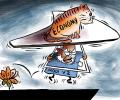
India's growth outlook has weakened sharply this year, with a crunch that started with the non-banking finance institutions spreading to retail businesses, car-makers, home sales and heavy industries.
Banks, through the Indian Banks' Association, have urged RBI and credit information companies to maintain a database of wilful defaulters.

A few state-owned banks such as IDBI Bank, Union Bank, Indian Overseas Bank have announced results for FY14.
The Asian Development Bank is all set to enter the Indian capital market with a bond issue to raise upto Rs 100 million (Rs 10 crore) as it has obtained the Reserve Bank of India's and ministry of finance's approval.

According to experts, banks have found better arbitrage opportunities in dollar terms in mature economies with mortgage and leverage rather than take equity exposure on Indian real estate.

India and the US on Thursday said they are looking forward to the reconvening of the India-US Trade Policy Forum later this year to further enhance trade relationship and identify new areas for engagement.

Irrespective of demonetisation and GST blues, IIM Lucknow has been able to successfully place their batch of 459 students.
Equity markets began the new financial year with smart gains on Friday, with the Sensex rallying over 708 points to recapture the crucial 59,000-mark following gains in index majors HDFC twins and Reliance Industries, along with foreign fund inflows. On the first day of trading in the new financial year, the BSE barometer rallied 708.18 points or 1.21 per cent to settle at 59,276.69. During the day, it jumped 828.11 points or 1.41 per cent to 59,396.62. The broader NSE Nifty advanced 205.70 points or 1.18 per cent to settle at 17,670.45.

Kochhar brothers stepped down from the board of Credential Finance by 2009. While Deepak Kochhar started NuPower Renewables, Rajiv set up Avista Advisory Group

Hindenburg Research has alleged that Adani Group was "engaged in a brazen stock manipulation and accounting fraud", a charge the conglomerate described as malicious, unsubstantiated, one-sided, and having done with malafide intention to ruin its share-sale.
 © 2026 Rediff.com - Advertise with us - Disclaimer - Privacy Policy - Sitemap - Feedback - About us - Terms of use - Grievances